Digital transformation in manufacturing means connecting machines, systems and people through shared data so decisions get faster and better. The clearest evidence so far is in maintenance, quality and planning. Buying the technology is the easy bit. Repeating one pilot’s results at the next plant is where many programs stall.
Two of the larger 2026 surveys on the topic were run or commissioned by companies that sell into it: Rockwell Automation sells industrial automation, and Rootstock sells ERP software. Their results may well hold up, but read them as directional. The sections below say who paid for what. businesswirerockwellautomation
Where digital transformation in manufacturing stands in 2026
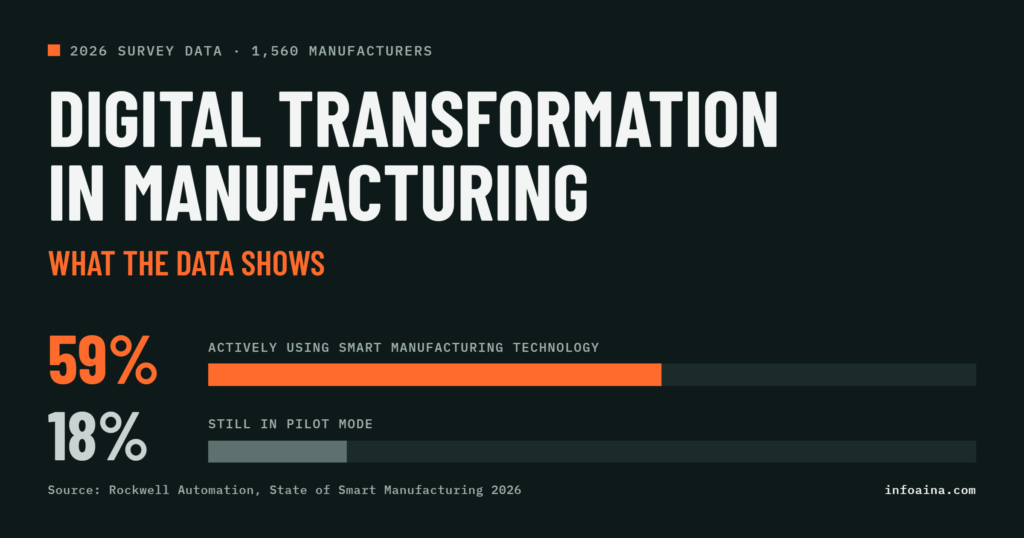
Rockwell’s 2026 State of Smart Manufacturing report (1,560 respondents in 17 countries, fieldwork by Sapio Research) found that 90% of manufacturers call digital transformation essential to staying competitive. In daily operations, 59% say they actively use smart manufacturing technology, and 18% are still in pilot mode. rockwellautomation
Rootstock’s survey of 520 digital transformation leads at mid-sized and large manufacturers in North America, Europe and Asia was commissioned by the ERP vendor itself. It found 61% planning to raise enterprise software spending over the next 12 months, and 94% saying they use AI in some capacity. Using AI in some capacity is a loose definition, so that figure says little about how deeply it’s used. businesswire
These numbers sit awkwardly beside an older one that the World Economic Forum (WEF) still repeats: more than 70% of companies investing in advanced analytics, AI or digital tools fail to get past the pilot stage. The WEF page traces it to a 2019 report, so treat it as dated. The 70% figure also measures something different from Rockwell’s active-use question. A plant can use a tool daily on one line and still be stuck at one line. weforum
Where digital transformation pays off
The evidence is strongest in three places. None of it comes from a neutral lab test, so each figure comes with a note on who reported it.
Predictive maintenance
Siemens’ 2024 True Cost of Downtime report gets quoted a lot, so it’s worth knowing what sits under it: 181 interviews with maintenance, engineering and IT staff at large industrial companies, covering April 2019 to March 2023 in automotive, fast-moving consumer goods, heavy industry, and oil and gas. siemens
An hour of unplanned downtime cost roughly $36,000 in fast-moving consumer goods and $2.3 million in automotive. The average large plant lost 27 hours a month to unplanned stops, down from 39 in 2019, and nearly half of the companies surveyed now have predictive maintenance teams, twice the 2019 share. siemens
Stops are rarer but slower to fix.
Average recovery time rose from 49 to 81 minutes, which Siemens attributes partly to lost maintenance skills, harder-to-source spare parts, and the fact that the easy faults now get caught early. siemens
Two caveats. The report’s headline figure, almost $1.4 trillion a year lost by the world’s 500 biggest companies, is an extrapolation from that sample rather than a count. And Siemens sells the predictive maintenance software behind its claimed client results of 50% less unplanned downtime and 40% lower maintenance costs, so those are a vendor’s own numbers. siemens
Quality and yield on old equipment
Many plants run older equipment, which makes this the example closest to an ordinary factory. In a WEF article by a Bosch software executive, ACG Packaging Materials in Shirwal, India trained machine-learning models on more than two years of golden-batch data (records of ideal production runs) and applied them to 60-year-old equipment. The reported results were a 37% improvement in first-pass yield and a 43% cut in quality set-up time. No greenfield site was needed. weforum
The article is an opinion piece, and the example comes from the WEF’s Lighthouse network, which recognizes best-in-class sites. It shows what’s possible, not what’s typical. weforumweforum
The WEF also describes a Singapore-based industrial automation maker that makes more than 1,000 products and changes its production lines more than 20,000 times a year. It deployed more than 50 digital and AI solutions and reported 43% more units per person-hour and 35% fewer defects. Note the count: more than 50 solutions at one site. weforum
Virtual planning and digital twins
BMW has built digital twins of more than 30 production sites. The company says virtual collision checks before a new model launches, which used to take up to four weeks of physical testing and sometimes meant clearing sections of a plant, now take about three days (Assembly magazine’s write-up). BMW also projects that planning costs could fall by up to 30%. The 30% figure comes from a June 2025 press release and is a projection, not a measured result. +++ Virtual automated collision checks ahead of new product launches +++ Core component of BMW iFACTORY +++ Up to 30-percent reduction in production planning costs projected +++ BMW Group to present Virtual Factory at NVIDIA GTC Paris +++ +3
What AI does on the factory floor
Rockwell’s survey says 34% of operations are AI-augmented today, in areas such as quality, cybersecurity and process optimization, and manufacturers expect more than half to be AI-supported by 2030. The second number is an expectation, not a measurement. rockwellautomation
Rootstock’s data shows where the money is moving. Predictive AI adoption rose 12 points to 48%, and AI investment shifted most toward supply chain planning (up 19 points, to 35%) and process optimization (up 11 points, to 36%). businesswire
Why these projects stall
Pilots don’t travel
Rakesh Kumar Murugan of Bosch’s software unit, writing for the WEF after more than 100 factory visits, says he has repeatedly seen the same pattern: a pilot is built around a strong local sponsor, one dataset and the best available team. At the next plant, definitions change, equipment interfaces differ, nobody clearly owns the result, and the economics look different. He calls it a context and operating-model problem more than a technology problem. weforum
The WEF’s own data points the same way. Even among the network’s standout operators, only 23 organizations had taken their transformation to three or more sites. weforum
Data nobody uses
Rockwell found that only 43% of the data manufacturers collect is used effectively. Siemens adds a technical angle: almost three-quarters of the companies it surveyed still rely on factory historians, which it describes as increasingly legacy because they lack the rich data that effective predictive maintenance needs. rockwellautomationsiemens
People and security
In Rootstock’s survey, 33% named a lack of the right talent as a primary barrier, and 31% named weak collaboration between departments. The labor market makes the first one harder, at least in the US. A 2024 Deloitte and Manufacturing Institute study projected that US manufacturers could need as many as 3.8 million more workers between 2024 and 2033, with 1.9 million of those jobs at risk of going unfilled, and found a 75% rise in demand for simulation software skills over five years. www.businesswire.com +2
Security belongs on the same list. Rockwell reports that 46% of manufacturers had at least one cyber incident in the past year, and says secure, integrated IT/OT architecture (office systems and plant-floor systems working together) is foundational to scaling AI and automation. More connected machines means more ways in. rockwellautomation
How to start without rebuilding the plant
The advice below is the common thread in the sources above, not a formula. Start with the problem that costs you the most.
| If your biggest pain is… | A sensible first project | What it needs first | Measure it by |
|---|---|---|---|
| Machines stopping without warning | Condition monitoring, then predictive maintenance | Sensor readings from your costliest machines, plus maintenance records | Unplanned downtime hours per month |
| Scrap or low first-pass yield | Machine learning on process and batch history | Clean records of past runs, with one agreed definition of “good” | First-pass yield, set-up time |
| New launches that eat weeks of plant time | Virtual layout and collision checks | CAD files, 3D scans and equipment data for the area | Days of physical trials avoided |
- Price an hour of your own downtime. Siemens’ figures run from $36,000 an hour in fast-moving consumer goods to $2.3 million in automotive, and reach $150,000 an hour at the top end for smaller manufacturers, so no benchmark replaces your own number. siemens
- Check what data you can actually get. Siemens found that 87% of large manufacturers collect some data that makes predictive maintenance possible, but only about half capture at least one of the three signals that help most: current, vibration and temperature. siemens
- Fix definitions before you build. Murugan’s minimum for every site: secure access to machine data, consistent definitions of key measures, clear ownership of decisions, frontline skills to use the tools, and a link from each use case to business value. Use the pilot to test that list, not only the model. weforum
- Ask the second-site question on day one. Before funding a pilot, ask what another plant would need to reuse it and who owns that reuse. Murugan also suggests requiring two business cases, one for local value and one for transfer value. weforum
- Put security in the first scope. With 46% of manufacturers reporting a cyber incident in the past year, treat it as part of the project, not a later phase. rockwellautomation
FAQ
What is digital transformation in manufacturing?
It’s the use of connected machines, data analysis, software and AI to run production with better information. Examples include sensors that flag a failing machine, models that predict defects, and a virtual copy of a factory used to test changes first. Surveys define the term loosely, so check what any given statistic counts.
Why do digital transformation projects in manufacturing stall?
Mostly for organizational reasons. Pilots built around one site’s team and data don’t carry over, collected data goes unused (43% effective use in Rockwell’s survey), and in Rootstock’s survey 33% of leaders cite a talent gap and 31% weak collaboration across departments. rockwellautomationbusinesswire
Is digital transformation realistic for small manufacturers?
Possibly, but the evidence is thinner. The big surveys cover mid-sized and large firms, and Siemens says its downtime data comes mainly from large manufacturers. It also argues that falling technology costs open the door for smaller suppliers, which is a vendor’s view. Start with one costly problem, not a company-wide program. siemens
What is a digital twin in manufacturing?
A digital twin is a virtual model of a machine, line or whole factory that’s used to test changes on screen before touching the real thing. BMW uses twins of more than 30 plants, and says collision checks that took up to four weeks of physical testing now take about three days. assemblymagbmwgroup
Check out other Articles to on infoaina